
Gosheni Destination
Ngorongoro Crater
Overview and Wildlife Habitat
The crater spans 260 km² (100 mi²), with its rim 610 metres (2000 ft) high. An eruption enriched the area with mineral-rich dust, fostering fertile soils. Underground rivers feed springs, bringing nutrients to the surface.
This environment supports permanent water sources, attracting animals. Their presence enriches the soil further, creating a productive grassland. Over time, swamps and forests emerged, hosting the planet’s densest concentration of large mammals.
Conservation History and Tourism
Ngorongoro Crater, named after the resonant sound of cattle bells once filling its expanse, has evolved from human habitation to a premier wildlife sanctuary. The removal of settlements enabled its transformation into a globally celebrated wildlife haven. It now stands as the core of the Ngorongoro Conservation Area, a World Heritage Site since 1959, lauded for its rich biodiversity and archaeological significance, including the pivotal Olduvai Gorge.
Flanked by the Serengeti and game-controlled zones, it forms a vast conservation mosaic where the Maasai people continue their traditional nomadic life, albeit without cattle grazing within the crater to protect its ecosystem. The crater, a biodiversity hotspot, shelters an estimated 25,000 large mammals.
Regulation and Access
Highlights Within Ngorongoro Crater
Picnic
There is a picnic area at the Ngoitokitok Springs where visitors can stretch and enjoy a meal.
Game Viewing
With an incredible diversity and abundance of game, visitors are all but assured of great sightings year-round.
Bird-watching
Over 500 species are represented in the overall conservation area, ranging from waterbirds to raptors.
Ngorongoro Tours
- 5 Days
- Tanzania
- 10 Days
- Tanzania
- 6 Days
- Tanzania
- 13 Days
- Tanzania
- 10 Days
- Tanzania

- Tarangire, Lake Manyara, Ngorongoro Conservation Area, Serengeti
Within the Ngorongoro Conservation Area
Olduvai Gorge
The site of some of the most significant finds relating to human evolution were made at this site, with a museum and guided tours.
Maasai or Hadzabe Cultural Experience
Guided tours can be arranged to gain insight into the history and traditions of these fascinating cultures.
Hiking
Guided walks on the crater rim and the surrounding landscape of the NCA can be arranged.
Hot Air Balloon Trip
Drift quietly over the savanna – a special treat when the Great Migration is underway.
Different areas of the Ngorongoro Crater & Ngorongoro Conservation Area
Within the Ngorongoro Conservation Area
Beyond the Crater
Activities
Game Drives
With half and full-day options available, visitors accompany an experienced guide to search the crater floor for the Big 5 and other wildlife species. All vehicles must exit the crater by 16h30
Cultural Visit
Gain an insight into the indigenous cultures of the area, with visits to local homesteads.
Picnic
Arrange a catered picnic at a designated site on the crater floor.
Bird-watching
Over 500 species await discovery by the avid birder visiting these parts.
Hot Air Balloon Trip
This tranquil experience offers a unique perspective of the landscape surrounding the crater.
Hiking
Numerous hiking trails criss-cross the landscape from the crater rim to nearby mountains. Note: walking trails are not permitted within Ngorongoro Crater.
Archaeological Excursions
Visit nearby archaeological sites to learn more about the evolution of humankind.
Wildlife
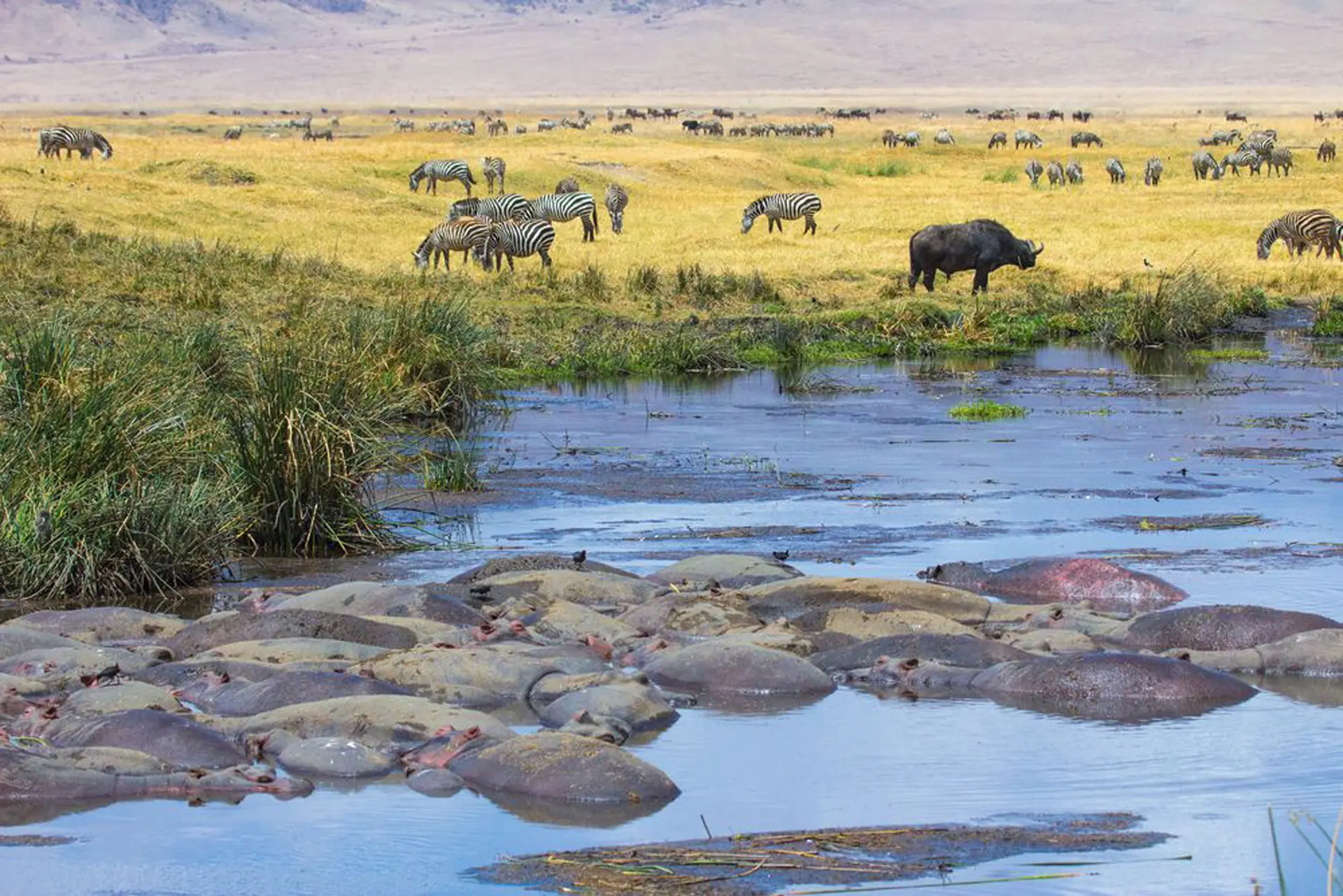


The Ngorongoro Crater is a prime wildlife viewing destination year-round, unaffected by the Great Migration, thanks to its ample food and water. Home to an estimated 25,000 large mammals, its flat terrain and sparse vegetation make spotting animals, especially after rains, easier. The crater boasts one of the highest densities of lions in Africa, though it faces challenges like inbreeding.
Spotted hyenas are common, while cheetahs, leopards, and African wild dogs are rarer, with leopards mostly in the Lerai Forest. Mega-herbivores such as hippos, buffalos, elephants, and black rhinos are prevalent, except giraffes. It also hosts wildebeest, zebra, warthogs, antelopes, and a rich variety of birds, making it a hub of East African wildlife diversity accessible throughout the year.
Landscape
The scenery throughout the conservation area is classic Africa. Gently rolling grasslands give way to hill country, with a few volcanoes rising high above the surroundings. Ravines are often thickly wooded, and numerous rivers snake across the landscape, their banks lined with large trees and lush floodplains.
Within the crater, surrounded by the steep caldera wall, one has the impression of being in a land that time forgot. At the foot of the slopes, forest surrenders to mixed woodland, and as the trees thin out, the flat savanna is a golden sea of grass. Around the lakes, a ring of green vegetation adds colour beneath the crisp blue sky.
Weather and Climate
Overall, the weather across the Ngorongoro Conservation Area is warm throughout the day, cooling significantly through the night, and becoming cold at times. Little rainfall is expected between June and October. From November to May, two periods of rain bring isolated showers, but it seldom rains for the whole day.
Best Time To Go
- Dry Season
- Wet Season
- Shoulder Season
During the Dry Season (June-September), short grass makes spotting the wildlife easier.
That said, during the Wet Season (November-May) the lush grass enhances the visual appeal.
Tourist numbers are high all year round, with a slight dip in numbers in April/May.
See What Our Guests Have to Say
Bien évidemment les big five (même le rhinocéros!), la traversée de la rivière par les gnous et bien d'autres animaux.
En faisant un safari avec Hassan vous trouverez tout ce que vous êtes venus chercher.
A l'avenir si nous décidons de refaire un safari, nous voudrions repartir avec Hassan.
Grâce à lui et sa grande expérience nous avons découvert et appris énormément de choses sur la Tanzanie, les animaux, les végétaux etc. Hassan est un véritable passionné qui aime transmettre son savoir.
En plus de ses connaissances, Hassan a un véritable œil de lynx et sais débusquer le moindre animal caché.
Grâce à Hassan nous avons eu la chance de voir beaucoup d’animaux et tous ceux du « Big Five ».
Parmi tous les véhicules présents lors des safaris, Hassan sait se frayer un chemin pour nous permettre d’avoir toujours le meilleur point de vue.
Hassan sait où se placer pour nous permettre d’avoir une vue sans égal sur les animaux, en les observant de très près.
Hassan est également un excellent conducteur. La route n’a aucun secret pour lui.
C’est également un guide très attentionné, toujours aux petits soins pour nous et d’une extrême gentillesse.
Nous recommandons Hassan les yeux fermés et si nous devions refaire un safari, nous demanderons d’être guidés par Hassan sans hésitation.
Merci encore à Hassan pour ces merveilleux moments qui resterons gravés dans notre mémoire !!
thx a lot for the thoughtful and excellent service
highly recommend
In summary the experience was highly satisfying, I sincerely recommend Gosheni Safaris and to ask for Wilson as a guide.
I booked this holiday back in 2020 but then had to cancel due to Covid. That was after a lot of research of tour companies and finally picking Ghosheni. The time was right to get this once in a lifetime trip set up again, so working via email with William at Gosheni we compiled the agenda…he was so helpful and we settled on one day in Tarangire, one day in Lake Manyara, three days in Serengeti and one day in Ngorongoro Crater…I’m now on the way to Zanzibar after an amazing experience, Gosheni took care of the whole package for my wife, three teenage sons and I.
Our guide and driver was Zadock, a humble, honest, genuine, proud and generous man. He did absolutely everything for us, answered every question and took us to all the places to see the big five up close, hunts and more.
The food was served every lunch time as a picnic, with plates, blanket, wtc whilst others had lunch boxes. The Jeep was cleaned daily, and was extremely comfortable along the difficult rough terrain…a credit to Zadock.
Zadock had so much knowledge not only of the animal kingdom’s hundreds of species but also the history of Tanzania, Africa, politics, and social customs, we felt as though he was part of our family.
Thankyou Zadock and Gosheni, I very rarely write reviews after holidays and I have travelled extensively around the world, but these guys are special and have made this so memorable for my family and I….I recommend to everyone if you are unsure about who, how, what, these guys will sort out the whole trip and at a very reasonable price.
Well done William, Gosheni and Zadock, and I really hope you get to be recognised as the number one tour company in Tanzania!
As our city had quarantine arrangement due to COVID-19, we were so worry about our trip. Luckily, Gosheni is so considerate and try their best endeavors to rearrange our scedule. With their assistance, everything is set and we feel comfortable for all of their kind arrangements.
During the safari, we have a terrific tour guide, Edward! He takes care of all the stuff and administration including liaison with hotels, lunch packing, other add-on safaris so that we can fully enjoy the trip.
Not only Edward spots a lot a lot of animals and birds for us, including the top 5 in the trip, he also introduces us the habitat and features of the animals and birds. We are very impressed by his rich knowledge and do enjoy listening the "stories" of the animals.
Edwward is definitely experienced and propose the best programme during the safari, e.g. he tries to maximise our time for the game drive in different locations and tribe visit. We fully trust his expertise and professionalism.
We are very happy with Edward and Gosheni. We will absolutely consider them in our next Africam safari.
The food was excellent, and even on the all-day game drives we had a cooked, sit-down meal for lunch which was a big plus point. All the accommodation was excellent as well.
We had a bespoke itinerary which we planned in advance with William from Gosheni, and he was extremely helpful in answering our questions and accommodating our requests.
I would highly recommend Gosheni and especially Ombeni for future travels.
The company is very professional from beginning to end. Peter the owner of Gosheni Safaris helped us a lot about planning our itinary. I asked too many questions and he replied all of them everytime. Sometimes he can be in the bush and has no internet connection but be sure he always will reply your questions. Just be sure that you are in safe hands and Hakuna Matata☺️
Our guide was Hassani who is a perfect guide, safari driver, friend and everything. He always did his best to show us as much as possible. We always felt safe and witnessed lots of amazing moments by help of Hassani. Beside being a perfect safari guide, he prepared very nice lunch tables every afternoon. He is very funny person and makes lots of jokes during the safari. I higly recommend Gosheni Safaris which is best one and Hassani who is a very good guide. I want to thank Hassani in person for making our safari perfect and looking forward to meet again??
Tips: I recommend ‘Morning Hot air Balloon safari’.


