
Gosheni Destination
Tarangire National Park
About Tarangire
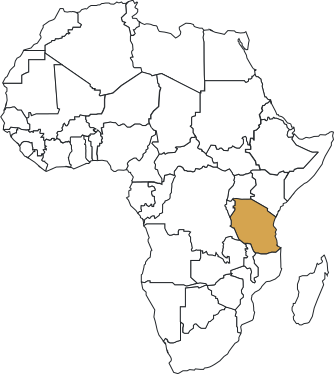
Considered by many safari aficionados as Tanzania’s best-kept safari secret, the Tarangire National Park was proclaimed in 1970, enlarging the area of its predecessor to incorporate more of the greater Tarangire ecosystem. Tarangire is Tanzania’s 6th largest national park, encompassing an area of some 2850 km² (1100 mi²), nearly the size of the state of Rhode Island (USA) or Luxembourg (EU).
It is named for the Tarangire River which runs from south to north through the reserve. ‘Tarangire’ is said to mean “winding river of warthogs” and while these are plentiful, there is much more to the park that makes it a worthwhile destination.
Overlooked by many as one has to detour slightly from the ever-popular Northern Safari Circuit, the Tarangire National Park is a vast haven for species also found in the more popular national. It has several species not found in the other locations, such as the fringe-eared oryx
Highlights
Elephants
some 3000 elephants converge on Tarangire during the dry season, with herds up to 300 strong. Excellent sights year-round.
Baobab Trees
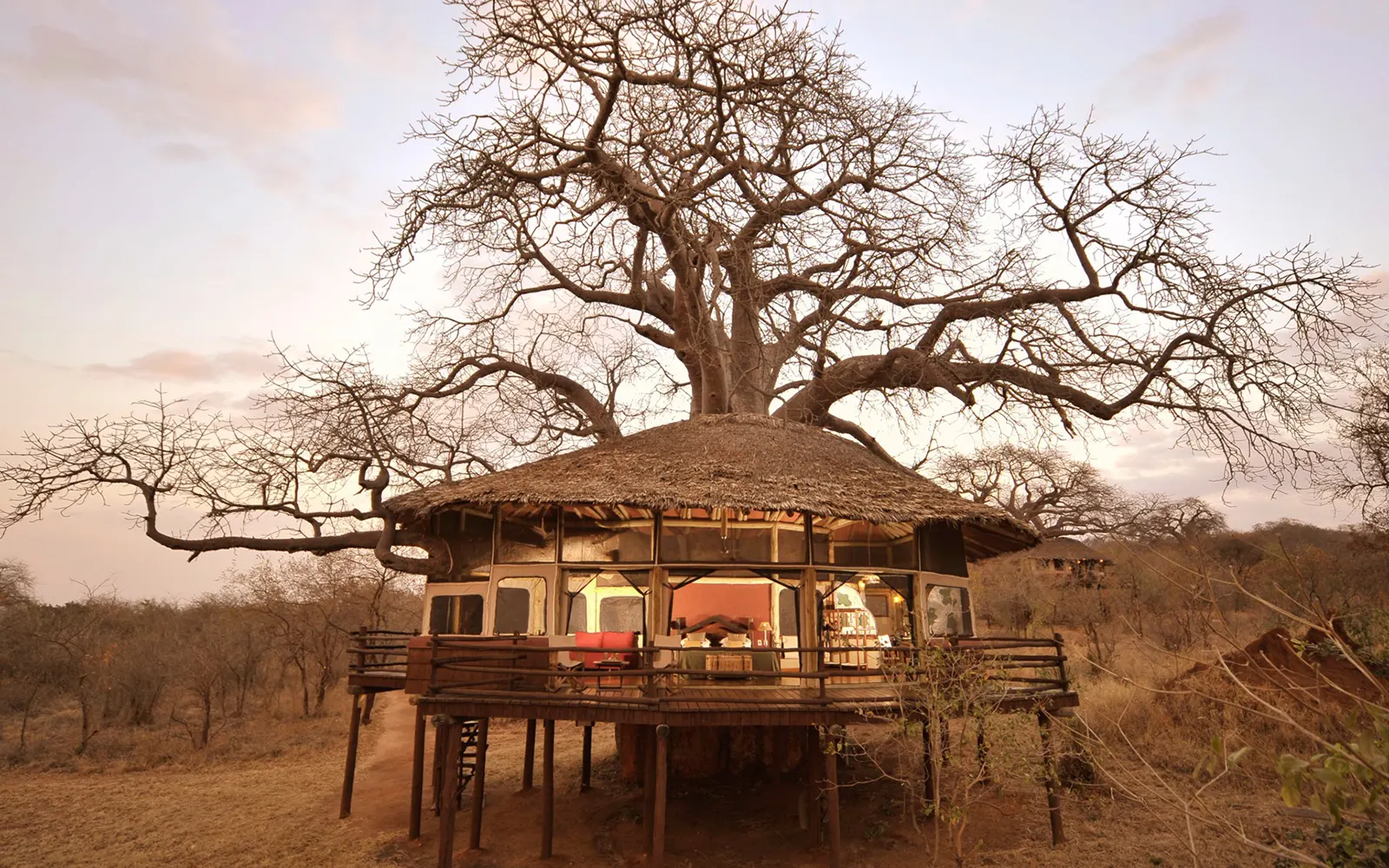
an abundance of these peculiar ‘upside-down trees’ are found within the park. Visitors can walk inside the “Poacher’s Hide” tree.
Bird-watching
A bird lover’s paradise, with over 500 species, including rare endemic species and summer migrants.
Rock Paintings
Hundreds of these artworks from prehistoric man can be found, particularly in the Kolo district, outside of the park.
Mini-Migration
Tanzania’s second largest migration occurs when wildlife converges on the Tarangire River during the dry season.
Unusual Species
Fringe-eared Oryx, the rare Coke’s hartebeests, long-necked gerenuk, dik-dik, grant’s gazelles, amongst others.
Predators
very good sightings of lions, cheetahs, leopards, and spotted hyenas. Also the possibility of highly endangered African wild dogs.
Tarangire Tours
- 5 Days
- Tanzania
- 10 Days
- Tanzania
- 6 Days
- Tanzania
- 13 Days
- Tanzania
- 10 Days
- Tanzania

- Tarangire, Lake Manyara, Ngorongoro Conservation Area, Serengeti
Different areas of the Tarangire
Activities
Game Drives
Setting out in the cooler hours of the day when the wildlife is most active, you will travel in a customized safari vehicle with an experienced guide in search of Africa’s big game. Full-day options are also available.
Night Game Drives
Permitted operators may offer night drives, where they will have the opportunity to view the park’s nocturnal species, such as civet and aardvark.
Walking Safaris
Permitted operators may offer walking safaris, where participants learn more about the plants and other finer details of the ecosystem.
Balloon Safaris
Drift quietly over the unsuspecting wildlife below in an early morning adventure that is truly unforgettable.
Bird-watching
With over 500 recorded species and numerous endemics and migratory visitors, the park is a bird lover’s paradise.
Wellness Treatments
Extend your sense of relaxation under the caring hands of trained therapists, incorporating traditional African treatments and familiar massage techniques.
Maasai and Barabaig Cultural Experiences
Visit traditional homesteads for a fascinating glimpse into these ancient cultures.
Rock Paintings
Take a day trip to the Kolo region nearby to view some of the hundreds of examples of prehistoric art adorning the rock formations.
Wildlife

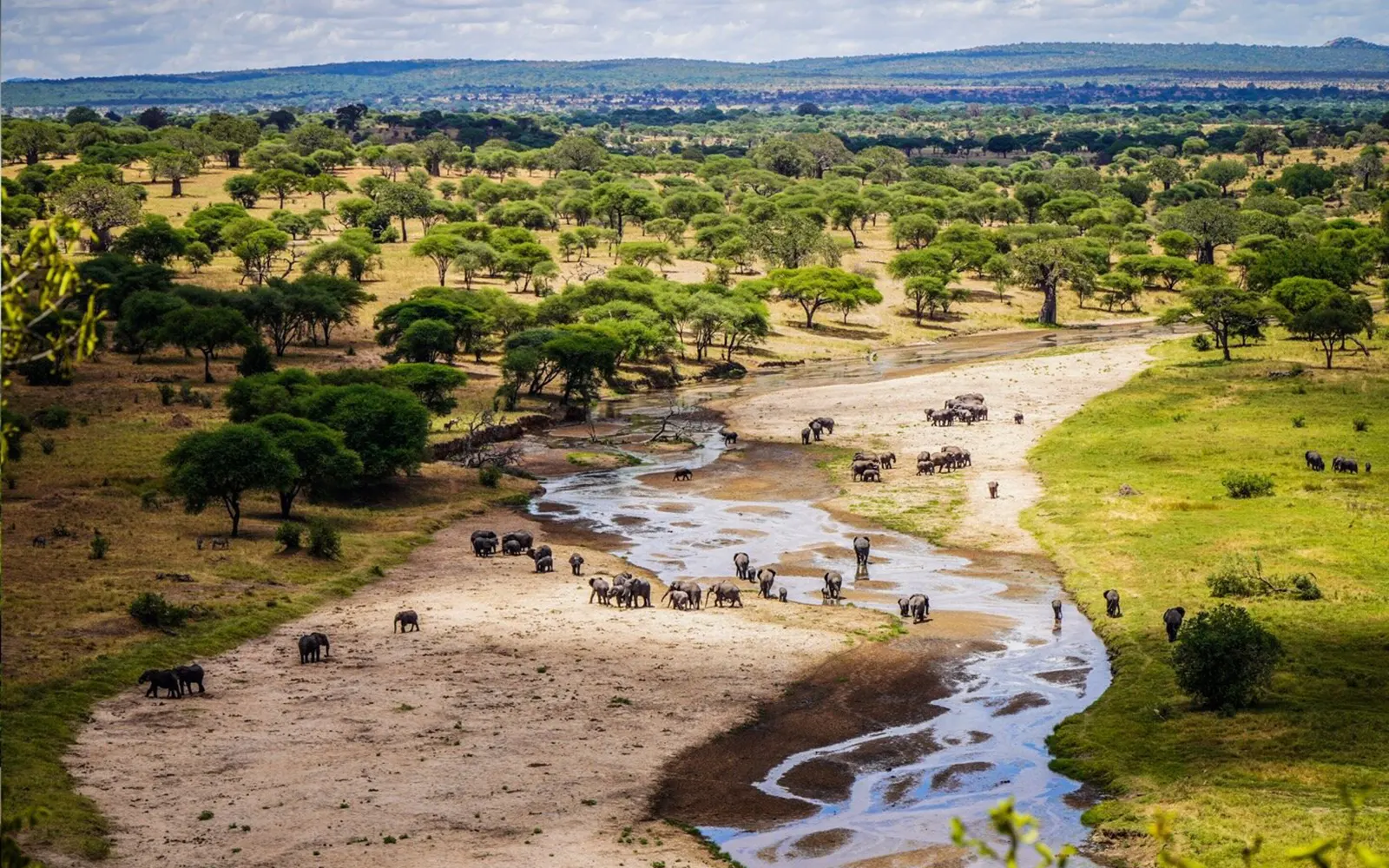
Tarangire National Park offers a serene wildlife experience, away from the crowded sightings of other Tanzanian parks. Wildlife abundance and diversity peak during certain seasons, with sightings fluctuating between the dry and wet seasons. The park is renowned for its large elephant population, potentially numbering up to 3,000, and also hosts a variety of other large herbivores and unique species not found in the Serengeti or Ngorongoro Crater, such as fringe-eared oryx and gerenuk. Predator sightings, including lions, hyenas, and leopards, are excellent, with Tarangire being one of the best places in Tanzania to see African wild dogs. The park is also a haven for bird enthusiasts, with over 545 species identified, including endemic species like the yellow-collared lovebird. The Tarangire River and its surrounding habitats play a crucial role in the seasonal migration and concentration of wildlife, making the park a must-visit for those seeking an intimate connection with Africa’s diverse fauna.
Landscape
Tarangire reveals itself to visitors in a range of beautiful landscapes and habitats. The course of the Tarangire River is flanked by floodplains and stands of riverine forest. In the north of the park, rolling savanna gives way to hill country dotted with thick-trunked baobabs and expanses of mixed combretum and acacia woodland. Low-lying areas are inundated in the wet season, leaving verdant swamps and wetlands brimming with the buzz of insects and song of birds. On the grasslands, abandoned termite hills several metres high are modified as new homes for dwarf mongooses and other burrowing species. While after the rains Tarangire is lush green, it can get very dry. Between grasslands, granite ridges, valleys, swamps and forests, Tarangire is a complex system of habitats that appeals to humans and wildlife alike.
Weather and Climate
January & February – A dry spell occurs after the short rains. The exact timing is difficult to predict.
March – May – ‘Long rains’ – On most days, rain occurs, although it rarely rains the entire day. Cloudy skies are common. Cold fronts commonly roll in during April and May causing temperatures to get much colder.
June – October – Typically no rain with temperatures ranging between 26°C/79°F and 14°C/57°
November – December – ‘Short rains’ – Unreliable wet season lasting up to four weeks, with brief showers each day. Daytime temperatures average 28°C/82°F, cooling to 16°C/61°F at night.
Best Time To Go
- Dry Season
- Wet Season
From June until October, the dry season offers the best game viewing, as animals migrate into the park and concentrate along the river. Vegetation is also sparse, improving the visibility of the animals.
During the wet season (November – May) some of the park may be inaccessible due to flooding. However, for bird-watchers, this is when they are at their most diverse and abundant.
See What Our Guests Have to Say
Bien évidemment les big five (même le rhinocéros!), la traversée de la rivière par les gnous et bien d'autres animaux.
En faisant un safari avec Hassan vous trouverez tout ce que vous êtes venus chercher.
A l'avenir si nous décidons de refaire un safari, nous voudrions repartir avec Hassan.
Grâce à lui et sa grande expérience nous avons découvert et appris énormément de choses sur la Tanzanie, les animaux, les végétaux etc. Hassan est un véritable passionné qui aime transmettre son savoir.
En plus de ses connaissances, Hassan a un véritable œil de lynx et sais débusquer le moindre animal caché.
Grâce à Hassan nous avons eu la chance de voir beaucoup d’animaux et tous ceux du « Big Five ».
Parmi tous les véhicules présents lors des safaris, Hassan sait se frayer un chemin pour nous permettre d’avoir toujours le meilleur point de vue.
Hassan sait où se placer pour nous permettre d’avoir une vue sans égal sur les animaux, en les observant de très près.
Hassan est également un excellent conducteur. La route n’a aucun secret pour lui.
C’est également un guide très attentionné, toujours aux petits soins pour nous et d’une extrême gentillesse.
Nous recommandons Hassan les yeux fermés et si nous devions refaire un safari, nous demanderons d’être guidés par Hassan sans hésitation.
Merci encore à Hassan pour ces merveilleux moments qui resterons gravés dans notre mémoire !!
thx a lot for the thoughtful and excellent service
highly recommend
In summary the experience was highly satisfying, I sincerely recommend Gosheni Safaris and to ask for Wilson as a guide.
I booked this holiday back in 2020 but then had to cancel due to Covid. That was after a lot of research of tour companies and finally picking Ghosheni. The time was right to get this once in a lifetime trip set up again, so working via email with William at Gosheni we compiled the agenda…he was so helpful and we settled on one day in Tarangire, one day in Lake Manyara, three days in Serengeti and one day in Ngorongoro Crater…I’m now on the way to Zanzibar after an amazing experience, Gosheni took care of the whole package for my wife, three teenage sons and I.
Our guide and driver was Zadock, a humble, honest, genuine, proud and generous man. He did absolutely everything for us, answered every question and took us to all the places to see the big five up close, hunts and more.
The food was served every lunch time as a picnic, with plates, blanket, wtc whilst others had lunch boxes. The Jeep was cleaned daily, and was extremely comfortable along the difficult rough terrain…a credit to Zadock.
Zadock had so much knowledge not only of the animal kingdom’s hundreds of species but also the history of Tanzania, Africa, politics, and social customs, we felt as though he was part of our family.
Thankyou Zadock and Gosheni, I very rarely write reviews after holidays and I have travelled extensively around the world, but these guys are special and have made this so memorable for my family and I….I recommend to everyone if you are unsure about who, how, what, these guys will sort out the whole trip and at a very reasonable price.
Well done William, Gosheni and Zadock, and I really hope you get to be recognised as the number one tour company in Tanzania!
As our city had quarantine arrangement due to COVID-19, we were so worry about our trip. Luckily, Gosheni is so considerate and try their best endeavors to rearrange our scedule. With their assistance, everything is set and we feel comfortable for all of their kind arrangements.
During the safari, we have a terrific tour guide, Edward! He takes care of all the stuff and administration including liaison with hotels, lunch packing, other add-on safaris so that we can fully enjoy the trip.
Not only Edward spots a lot a lot of animals and birds for us, including the top 5 in the trip, he also introduces us the habitat and features of the animals and birds. We are very impressed by his rich knowledge and do enjoy listening the "stories" of the animals.
Edwward is definitely experienced and propose the best programme during the safari, e.g. he tries to maximise our time for the game drive in different locations and tribe visit. We fully trust his expertise and professionalism.
We are very happy with Edward and Gosheni. We will absolutely consider them in our next Africam safari.
The food was excellent, and even on the all-day game drives we had a cooked, sit-down meal for lunch which was a big plus point. All the accommodation was excellent as well.
We had a bespoke itinerary which we planned in advance with William from Gosheni, and he was extremely helpful in answering our questions and accommodating our requests.
I would highly recommend Gosheni and especially Ombeni for future travels.
The company is very professional from beginning to end. Peter the owner of Gosheni Safaris helped us a lot about planning our itinary. I asked too many questions and he replied all of them everytime. Sometimes he can be in the bush and has no internet connection but be sure he always will reply your questions. Just be sure that you are in safe hands and Hakuna Matata☺️
Our guide was Hassani who is a perfect guide, safari driver, friend and everything. He always did his best to show us as much as possible. We always felt safe and witnessed lots of amazing moments by help of Hassani. Beside being a perfect safari guide, he prepared very nice lunch tables every afternoon. He is very funny person and makes lots of jokes during the safari. I higly recommend Gosheni Safaris which is best one and Hassani who is a very good guide. I want to thank Hassani in person for making our safari perfect and looking forward to meet again??
Tips: I recommend ‘Morning Hot air Balloon safari’.


