
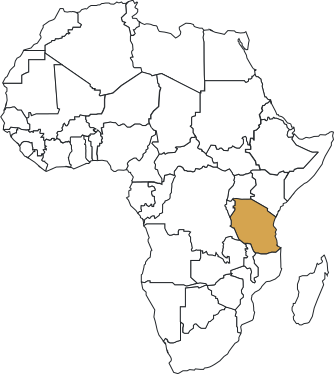
Located in the great lakes region of East Africa, Tanzania is the thirteenth largest country in Africa. It is bordered to the north by Kenya and Uganda, to the east by Burundi, Rwanda and the Democratic Republic of Congo, to the south by Mozambique, Malawi, and Zambia. This breathtaking country is home to some of the best safari attractions in the world, including the , rich cultural heritage, and over 120 distinct Tanzania tribes and ethnic groups. This remarkable number of tribal groups highlights the country’s rich cultural diversity, with each tribal group contributing unique traditions, languages, and customs that shape Tanzania’s national identity. The rich history of Tanzania’s tribes is reflected in their longstanding traditions and significant contributions to the nation’s heritage.
Here are some of Tanzania’s most diverse, unique and indigenous tribes:
Overview of Tanzanian Tribes
Tanzania is a vibrant tapestry of over 120 ethnic groups, each contributing to the country’s rich cultural heritage. This incredible diversity is reflected in the customs, languages, and traditions that define daily life across the nation. The largest ethnic group in Tanzania is the Sukuma tribe, making up nearly 13% of the population and playing a significant role in the country’s social and cultural landscape. Alongside the Sukuma, other influential tribes such as the Nyamwezi, Chagga, and Maasai have shaped Tanzania’s history and identity through their unique cultural practices and traditions. The presence of so many tribes has fostered a spirit of inclusivity and respect for cultural diversity, making Tanzania a true mosaic of ethnic groups and a destination where visitors can experience a wealth of cultural heritage.
Tribal Diversity
Tanzania’s tribal diversity is one of its most defining features, with a wide array of ethnic groups including Bantu, Nilotic, and indigenous hunter-gatherer communities. Each group brings its own distinct traditions and skills to the national identity. The Makonde tribe, for instance, is celebrated for its intricate woodcarvings and artistic expression, which have gained international recognition. The Maasai tribe is renowned for its vibrant cultural heritage, traditional attire, and enduring pastoralist lifestyle. Meanwhile, the Hehe tribe stands out in Tanzania’s rich cultural history for their resilience and warrior traditions, having famously resisted both slave traders and colonial rule in the 19th century. These diverse cultural practices and historical experiences highlight the depth and complexity of Tanzania’s ethnic groups, making the country a living testament to the endurance and adaptability of its people.
How Many Tribes Are in Tanzania?
Tanzania is home to an estimated 120 to 130 tribes, each with its own unique language, customs, and traditions. The exact number can vary depending on how certain groups are classified, but what remains constant is the remarkable variety of ethnic groups found throughout the country. Major tribes such as the Sukuma, Nyamwezi, Chagga, Maasai, and Makonde are spread across different regions, from the fertile lands of northern Tanzania and the plains near southern Kenya, to the heart of central Tanzania and the east African coast. Each tribe maintains its own cultural practices, contributing to the country’s dynamic social fabric. This diversity is not only a source of pride for Tanzanians but also a key attraction for visitors eager to experience the many facets of the nation’s cultural identity.
5 TANZANIA TRIBES YOU SHOULD BE MEETING IN YOUR TANZANIA TOUR
1. THE HADZABE TRIBE
This indigenous ethnic group resides in north-central Tanzania, dwelling near Lake Eyasi in the central rift valley and in the neighboring plateaus of the Serengeti. The Hadzabe are one of the remaining hunter gatherer tribes in Tanzania, maintaining a traditional lifestyle that is increasingly rare. The impact of tourism and pastoralist encroachment has for many years posed a severe threat to the continuation of their traditional way of life.
HISTORY
The oral history of the Hadzabe’s tribes past is divided into four epochs, with each epoch inhabited by a different culture. The archaeological and genetic history of the Hadza’s reveals that they are not closely related to any other tribe, although their language was once classified with the Khoisan languages because it has clicks, there is relatively no evidence that they are related.
The Hadzabe tribe became part of the German East Africa but soon came under British control at the end of the first world war. Several attempts were also made by the British and the Tanzanian government to make the Hadzabe settle and adopt farming, but all their attempts failed as the Hadzabe people only settled to take advantage of the food provided, but leave and go back to foraging when the supply of food runs out.
WHAT THEY ARE KNOWN FOR?
As one of the descendants of Tanzania’s aboriginal hunter-gathering population, the Hadzabe tribe has a division of labour that is split between foraging and hunting. While Hadzabe men usually forage individually, women are known generally to forage with at least one adult male accompanying the group. The Hadzabe women usually carry digging sticks, large skin pouches for carrying items like knives, shoes, clothing and various other items held in the pouch around their neck, with a grass basket for carrying berries while foraging.
Their diet consists mainly of honey, fruits, tuber, and meat. The availability of meat to their diet increases during the dry season when men often hunt in pairs hoping to shoot animals with their bows and poisoned arrows. They are highly skilled hunters and are known for their selective skills in hunting, foraging and their vast knowledge of plants, fruits, tubers, and wild animals.
NATURAL HABITAT
The Hadzabes reside around Lake Eyasi, located just south of the Serengeti. Their lands are full of mostly baobab fruit trees and other bush trees that provide for their livelihood.
CULTURE
The Hadzabe’s are semi-nomadic hunter-gatherers that are culturally and linguistically members of the Khoi (Person) and San (Foragers) group. They have close affinities with the Sandiwe people who possess cultural connections with the Khoekhoe hunter-gatherers communities of Southern Africa.
Women are adorned with “Hangweda“ made of local pieces of skin, while the Hadzabe men are polygamists with a patriarchal social system.
Check out this video of tourists visiting the Hadzabe tribe!
2. THE DATOGA TRIBE

(c) Flickr
Known as the Mang’ati in Swahili, Datoga people are known as an agro-pastoral nomadic Nilotic speaking tribe, residing in Manyara and Singida region of north-central Tanzania near Mt Hanang, lake Basotu and Lake Eyasi. With well over 10 subtribes, its best subtribe is the pastoral Barabaig who also reside mainly in the northern volcanic highlands encompassed by Mt Hanang which is a sacred mountain to the Barabaig.
HISTORY
Their migratory history has been somewhat reconstructed through the study of comparative linguistics and oral tradition of the Datoga and its neighbors. They are said to be from South Sudan or Western Ethiopia highlands. As their ancestors gradually migrated southward, this resulted in settlements in the highland areas of Kenya and Tanzania by speakers of Nilotic languages, herding, and farming in the rich highlands by about AD 1500.
WHAT THEY ARE KNOWN FOR?
The Datoga tribe consider themselves as the oldest tribe in Tanzania (other tribes like the Maasai and the Bushmen also claim this fame). They are characteristically known for keeping to themselves and are a tribe of proud people and fierce warriors known for their stealth ability. They are skillful and are also known for their blacksmith skills, beads works, brass bracelets, and necklaces, while also supplying arrowheads to the Hadzabe tribe. Though they are known to herd goats, donkeys, sheep and raise chickens, cattle are their most important domestic animals.
HABITAT
The Datoga tribe resides in the Singida and Manyara region of north-central Tanzania close to the Mt Hanang, Lake Eyasi, and lake Basotu.
CULTURE
The Datoga’s through the color of their outfits, blend in with their environment with a reddish brown color soil outfit, reddish patched leather dresses, beadworks, bracelets, and necklaces. Another cultural identity and feature of theirs that distinguishes them from other tribes is their decorative tattooing around their eyes in circular patterns.
3. THE SONJO TRIBE

(c) geminiresearchnews.com
The Sonjo people are a Bantu people and their primary way of life is based solely on herding and agriculture. They are known to use traditional irrigation systems when farming.
HISTORY
The Sonjo people are said to have lived in northern Tanzania for centuries secluded within the Maasai territory. They are believed to have migrated to East Africa 400 years ago from Central Africa.
WHAT THEY ARE KNOWN FOR?
The Sonjo tribe is known for their agricultural way of life which was believed to be the major reason their migration took place little by little over thousands of years in search of fertile and well-watered land to cultivate their crops.
HABITAT
The Sonjo tribe reside in northern Tanzania, in the Ngorongoro district about 30-40 miles west of Lakes Natron.
CULTURE
Music plays a forestanding role in the Sonjo culture. Music shapes their entire way of life and is a widely practiced art in the entire community. It is used for several ritual purposes, rainmaking ceremonies, healing ceremonies, marriages, and other festive or civil events.
4. THE MAASAI TRIBE

(c) Campi ya Kanzi
An indigenous group of semi-nomadic people that settled in northern Tanzania and Kenya. The Maasai tribe are internationally known and are among the most popular ethnic groups due to their distinct traditions, clothing, and their close residence to the many national parks in East Africa. Their ancestral lands, which now include parts of these national parks and tourist regions, remain central to their cultural identity, traditions, and spiritual practices.
HISTORY
According to oral history, they originated North of Lake Turkana (north-west of Kenya) in the lower Nile valley. In the 15th century, they began migrating south and arrived along a land stretching across Tanzania and Kenya border, covering the Great Rift valley and adjacent lands from Dodoma and Mt Marsabit.
WHAT THEY ARE KNOWN FOR?
The Maasai tribe are known for their brightly colored outfits and traditional lifestyle concentrated on cattle which make up the primary source of food. The wealth of a man is measured in terms of children and cattle but is also considered poor if he has many cattle but not children. Social status among the Maasai is determined by factors such as cattle ownership, the number of children, and participation in important ceremonies, all of which reflect an individual’s rank within the community. Though they use spears and shields, they were most feared for their ability to expertly throw the orinka (club) from up to 70 paces(100 meters approximately).
HABITAT
The Maasai tribe resides north of Lake Turkana (northwest Kenya) in the lower Nile valley and northern Tanzania.
CULTURE
Firmly patriarchal in nature, most major disputes and matters are sometimes resolved or determined by retired elders and elder Maasai men. Maasai culture is characterized by a strong social organization, distinctive warrior traditions, and elaborate rituals that play a central role in their community life. They are monolithic in nature and believe in their god called Enkai or Engai. The Maasai music comprises traditionally of rhythms rendered by a chorus of harmonies sung by vocalists while the olaranyani (song leader) sings the melody.
5. THE CHAGGA TRIBE

(c) flickr
The Chagga people (also known as Wachagga, Jagga, Dschagga, Waschagga) are a Bantu speaking indigenous and the third largest ethnic group in Tanzania tribes. They are part of the Bantu ethnic group, with deep historical roots in the region.
HISTORY
The Chagga tribe were divided into small autonomous chiefdoms traditionally belonging to different clans ruled by Mangis (chiefs). The system of chiefdom was practiced until it was abolished throughout the country after Tanzania’s independence in 1961.
WHAT THEY ARE KNOWN FOR?
The Chagga tribe are known for their sense of enterprise, politics and strong work ethics. They engage in small scale businesses, while the young workers are clerks, teachers, and administrators.
HABITAT
The Chagga tribe resides on the southern slopes of Mt Kilimanjaro which has two peaks namely Kibo and Mawenzi.
CULTURE
Greetings are an important part of Chagga culture. Their marriage ceremonies were usually a long process traditionally, beginning with betrothed proceedings that continue long after the couple was married.
Today, Christian couples are married in churches with great importance placed on giving birth to a son to continue the lineage. At the age of 12, a rite called Kisusa is carried out for every child performed to curb unruliness, and after a month, a purification ceremony is celebrated, and a goat is sacrificed.
Want to learn more about these tribes or schedule a safari visit to Tanzania, get in touch with us today by calling or filling our out contact form.
Community Development
Community development is at the heart of many Tanzanian tribes’ efforts to preserve their cultural heritage while embracing progress. Across the country, tribes are initiating projects that support education, healthcare, and economic growth, all while maintaining their unique traditions. The Maasai tribe, for example, has launched community-based programs that empower local people and promote sustainable development. The Makonde tribe has turned their renowned woodcarving skills into a thriving industry, supporting families and keeping their artistic heritage alive. In the Iringa region, the Hehe tribe has fostered agricultural and entrepreneurial initiatives that strengthen community bonds and improve livelihoods. These efforts, mirrored by many tribes throughout Tanzania, not only enhance the quality of life for local communities but also celebrate the country’s rich cultural diversity and ensure that traditional knowledge is passed down to future generations.
Conclusion
Tanzania’s tribes are the cornerstone of the country’s rich cultural heritage and vibrant national identity. With over 120 ethnic groups, each with its own language, customs, and traditions, Tanzania stands as a beacon of cultural diversity in East Africa. The major tribes—including the Sukuma, Nyamwezi, Chagga, Maasai, and Makonde—have left an indelible mark on the nation’s history and continue to shape its future through their traditional practices and community initiatives. Preserving this cultural heritage is vital, not only for fostering unity and national pride but also for attracting visitors eager to experience Tanzania’s diverse cultures and stunning landscapes. By supporting community development and celebrating the unique contributions of each ethnic group, Tanzania ensures that its rich cultural diversity remains a source of strength and inspiration for generations to come.
Ready to Experience Tanzanian Warmth in 2026?
These carefully crafted adventures are trips that our US guests often choose & can be fully tailored to your travel dates, budget & interests:


