

7 Days Rongai Route
7-day Rongai Route climb on Mount Kilimanjaro from Moshi to Uhuru Peak
Overview
7-day Rongai Route climb
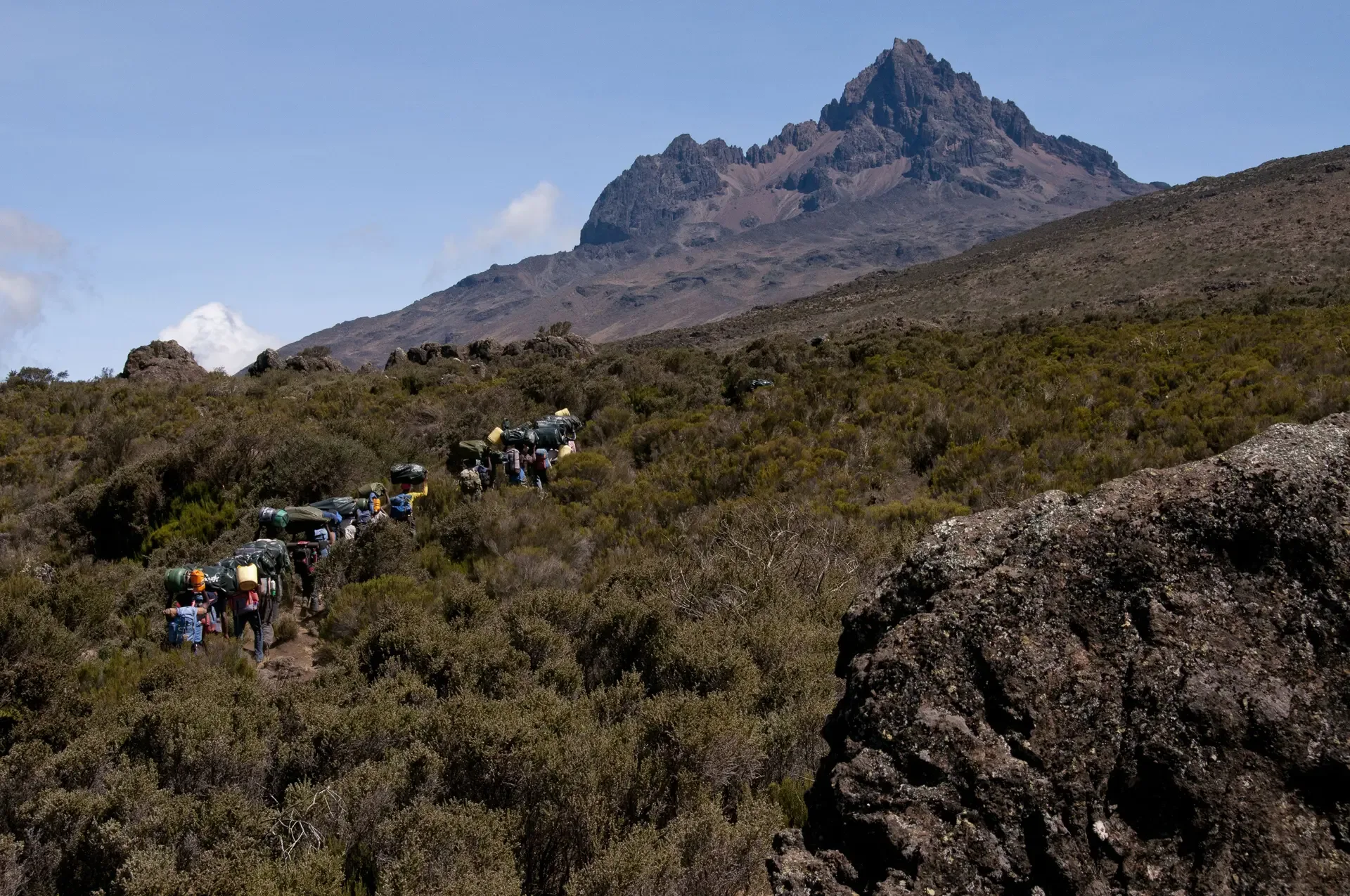
For a 7-day Rongai Route climb, approach Kilimanjaro from the north along the Kenyan border.
The Rongai route ascends Kilimanjaro from the northeastern side of the mountain, along the border between Tanzania and Kenya. This route retains a sense of unspoilt wilderness and offers a different perspective of Kilimanjaro by approaching it from the north. The topography of the route does not allow for the application of the climb high and sleep low principle and hikers generally suffer more from altitude sickness on the Rongai route compared to other routes (an additional acclimatization day is highly recommended on this route). The Rongai route use the scree summiting path from Kibo hut to Gilman’s point and descend via the Marangu route. The main itinerary difference between the Rongai 6 day and 7 day routes is the additional acclimatization day at Mwenzi Tarn.
Travel logistics
Start / Finish
Start
- Moshi
- JROKilimanjaro International Airport
Finish
- Moshi
- JROKilimanjaro International Airport
Highlights
Expedition Highlights
Explore Mount Kilimanjaro
7 days fully guided
| Day | Place | Elevation (m) |
|---|---|---|
| 2 | Rongai Start Point | 1996 |
| 2 | Simba camp | 2626 |
| 3 | Kikelewa Camp | 3679 |
| 4 | Mawenzi Tarn camp | 4303 |
| 5 | Kibo hut | 4730 |
| 7 | Horombo hut | 3705 |
| 7 | Marangu Gate | 1860 |
Day by Day
7-day Rongai Route climb itinerary
You will be picked up by the staff of Gosheni Safaris from Kilimanjaro International Airport (JRO) and driven to your accommodation in Moshi. Participants will be given a short briefing for the climb the next day. Kits and the necessary equipment will be checked as well.
- Elevation
- 1,996 m (6,549 ft) → 2,626 m (8,615 ft)
- Distance
- 6.7 km (4.2 mi)
- Walking
- 4 hours
- Zone
- Rainforest
Hiking time: 4 hours Distance: Approximately 6.7km Habitat: Forest (Montane)
We depart from Moshi town and drive 45mins. to Marangu park gate for registration. From there, we travel to Naro Moru, a further 68km and approximately 2 ½ hours on bad roads to the Rongai starting point (1996m). We begin our hike from the Nale Moru village. The small winding path crosses maize fields before entering pine forest, and then we climb gently through a forest. The trail is not steep, but is rather a gentle hike through a beautiful countryside. The first night’s camp is at Simba Camp (2626m). The camp facilities include a public toilet and a wooden table with benches, but no hut.
- Elevation
- 2,626 m (8,615 ft) → 3,679 m (12,070 ft)
- Distance
- 11.8 km (7.3 mi)
- Walking
- 6-7 hours
- Zone
- Heath & moorland
Hiking time: 6-7 hours Distance: Approximately 11.8 km Habitat: Moorlands
We hike from Simba camp to Kibo (3482m). We arrive for lunch at First Caves. The distance is 5.8km. After lunch, we continue trekking until we reach Kikelewa Camp at about 3679m. Here you will have an amazing view including a stream of water below the cave.
- Elevation
- 3,679 m (12,070 ft) → 4,303 m (14,117 ft)
- Distance
- 3.7 km (2.3 mi)
- Walking
- 3 hours
- Zone
- Heath & moorland
Hiking time: 3 hours •Distance: Approximately 3.7km •Habitat: Moorlands
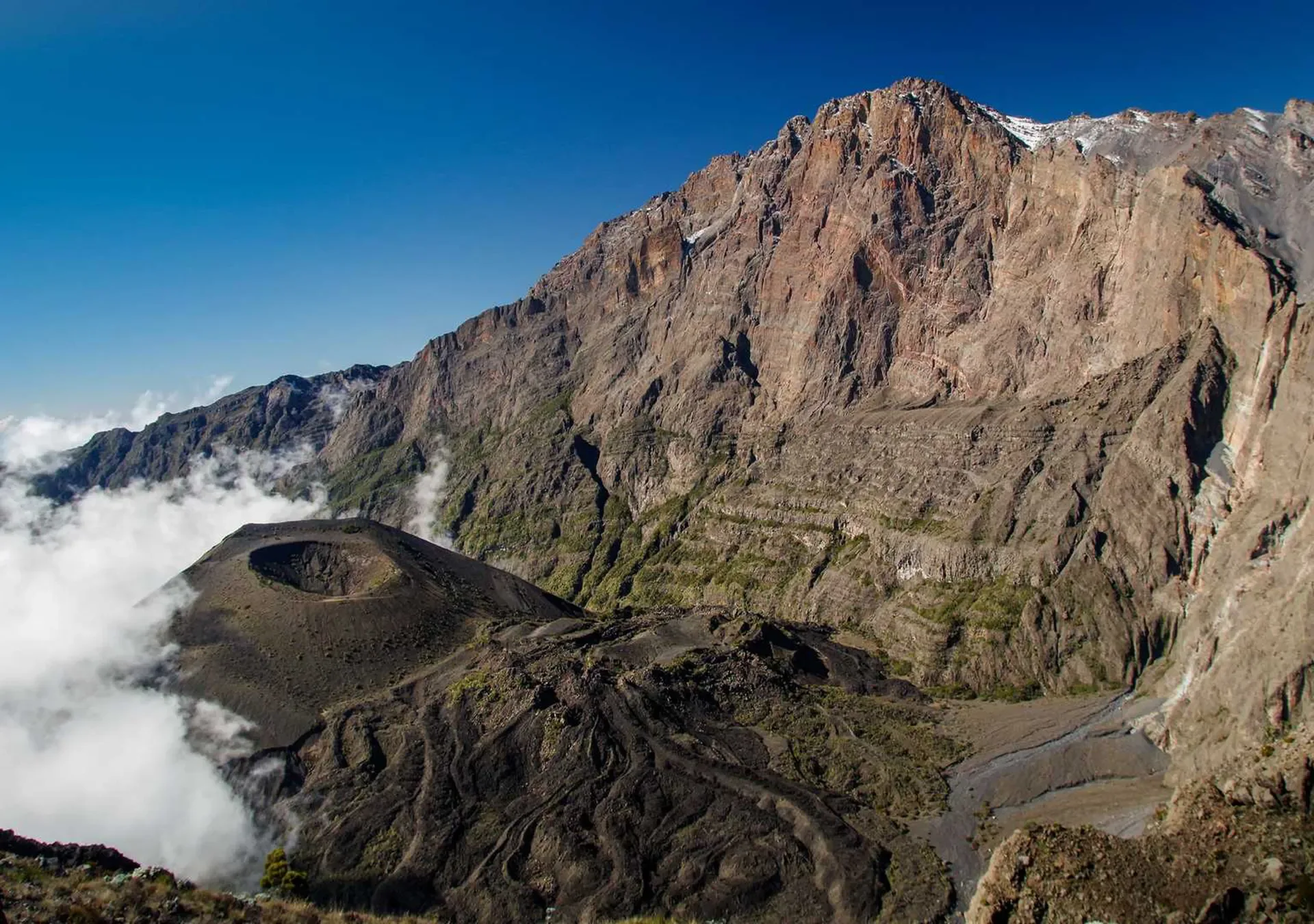
A short but steep climb up grassy slopes offer superb views of this wilderness area. The vegetation zone ends shortly before you reach your next camp at Mawenzi Tarn situated beneath the towering spires of Mawenzi. Here we spend the afternoon acclimatizing and exploring the area.
- Elevation
- 4,303 m (14,117 ft) → 4,730 m (15,518 ft)
- Distance
- 9 km (5.6 mi)
- Walking
- 5 hours
- Zone
- Alpine desert
Hiking time: 5 hours Distance: Approximately 9 km Habitat: Alpine desert
After breakfast, we head west and continue ascending on the east side of Kibo. We then cross the saddle between Mawenzi and Kibo taking 4 to 5 hours to reach Kibo Hut. The remainder of the day is spent resting in preparation for the final ascent, which begins around midnight. Overnight at Kibo hut.
- Distance
- 5.4 km (3.4 mi)
- Walking
- 7-8 hours
- Zone
- Alpine desert
Kibo hut (4730m), Uhuru Peak (5895m), Horombo hut (3705m)
Hiking time: 7 to 8 hours to reach Uhuru Peak | 6 to 8 hours to descend to Horombo
Distance: Approximately 5.4km ascent and 15 km descent Habitat: Stone scree / ice-cap summit
The total time spent walking on this day is around 14 hours, so be prepared for a very tough day. You will rise around 23h20, and after some tea and biscuit, we begin our ascent. The first section of the trail consists of a rocky path to the Hans Meyer Cave (5150m), also a good resting spot. The path then zigzags up to Gillman’s point (5681m), which is located on the crater rim. This section is very steep with a lot of stone scree, requiring a great physical and mental effort. This is probably the most demanding section of the entire route. From Gillmans Point, you will normally encounter snow all the way up to Uhuru peak (5895m), the highest point in Africa!
Weather conditions on the summit will determine how long you will be able to spend taking photographs and enjoying the amazing scenery. Afterwards, we begin our 3-hour descent back to Kibo hut. After a short rest at Kibo hut, we gather all our remaining gears and head down to Horombo hut (3 hours) for your overnight. The return to Horombo hut will seem surprisingly fast compared to the ascent. Later in the evening, you will have your last dinner on the mountain and have a well-earned sleep.
- Elevation
- 3,705 m (12,156 ft) → 1,860 m (6,102 ft)
- Distance
- 19.7 km (12.2 mi)
- Walking
- 6 hours
- Zone
- Heath & moorland
Hiking time: 6 hours Distance: Approximately 19.7 km Habitat: Moorland & Montane Forest
After breakfast, we continue our descent for around 6 hours passing the Mandara hut down to the Marangu gate. At Marangu gate, successful climbers receive their summit certificates. Those climbers who reached Gillman’s Point (5685m) are issued with green certificates, and those who reached Uhuru Peak (5895m) receive gold certificates. Afterwards, we drive back to Moshi for a long overdue hot shower and celebration.
Gallery
Photographs
Where You Stay
Before & After
the Mountain
Where you rest before the climb begins and recover once you are back down.
Private climb prices
What it costs, per person
Prices in USD, per climber, for a private climb on your own dates. The more of you there are, the less each pays.
Your group
$2,625per person$5,250total for 2 climbers
Classic · 2 climbers rate. The exact figure is confirmed for your dates.
Classic
A full-service expedition: professional mountain crew, quality camping, all park fees and meals.
- 1 climber
- $3,060
- 2 climbers
- $2,625
- 3 climbers
- $2,400
- 4 climbers
- $2,285
- 5 climbers
- $2,225
- 6 climbers
- $2,185
- 7 climbers
- $2,135
- 8-10 climbers
- $2,080
Signature
The same expedition and the same safety, with the comfort that matters most at altitude.
- Walk-in tents you can stand up in
- Camp beds with thick mattresses, pillows and proper bedding
- An upgraded mountain menu from a dedicated chef
- A 5-star hotel before and after the climb, with dinner
- A satellite phone for personal calls
- A hot-water washing tent
- A personal porter for your day pack
- 1 climber
- $5,050
- 2 climbers
- $4,330
- 3 climbers
- $3,960
- 4 climbers
- $3,770
- 5 climbers
- $3,670
- 6 climbers
- $3,605
- 7 climbers
- $3,525
- 8-10 climbers
- $3,430
Park fees, your mountain guides, cook and porters, all meals on the mountain, camping equipment and a hotel night before and after the climb are included. International flights are not. Rates move with the season. Tell us your dates and we will confirm the exact figure.
Dates & prices
Set departures you can join
Prices are per person sharing, in USD. Park fees, accommodation and guiding are included; international flights are not.
What's Included
Inclusions & Exclusions
Included
- Airport transfers, and all transfers to and from the park gates
- A hotel night before and after the climb (bed & breakfast)
- All park entry, camping or hut, and rescue fees, with VAT
- Professional mountain guides, cook and porters
- All meals on the mountain and treated drinking water
- Camping equipment: sleeping tents, mess tent, tables, chairs and sleeping mats
- A private toilet tent
- Emergency oxygen, and pulse-oximeter health checks on the mountain
Not Included
- International flights
- Visa fees
- Travel insurance (it must cover trekking to 6,000 m)
- Tips for the mountain crew
- Personal gear and rentals, such as a sleeping bag or trekking poles
- Single supplement
- Lunch, dinner and drinks at the hotel
Questions
Frequently Asked
Have questions about this climb? Ask our team, we're happy to help you prepare.
Ready?
Start Planning
Your Climb
Tell us your dates and group size and our team will send a personalized quote within 24 hours. Free, no obligation.
Join a set date (5 open)Want different lodges, more days, or another route?
Opens the trip planner with this itinerary loaded, day by day.
Explore More
Continue Your
Adventure
Pair the climb with a safari or a few days on the coast, or compare other ways up the mountain.