Short answer
The best place to see African wild dogs in Tanzania is Nyerere National Park, the former Selous Game Reserve, followed by Ruaha National Park. Both hold some of the largest wild dog populations left in Africa. Mikumi has packs too, but sightings there are less common. In the north, dogs live in Loliondo, east of the Serengeti, and are only seen now and then. Go in the dry season, June to October, and aim for June to August if you can, when many packs are denning and stay in one area for a few weeks. Even then, nobody can promise a sighting.
Most of our guests start in the north, with the Serengeti and Ngorongoro. When they ask what else Tanzania has, the painted dog is often our answer: wilder southern parks, fewer vehicles, and no promise that the animal you came for will show up.
What is a painted dog?
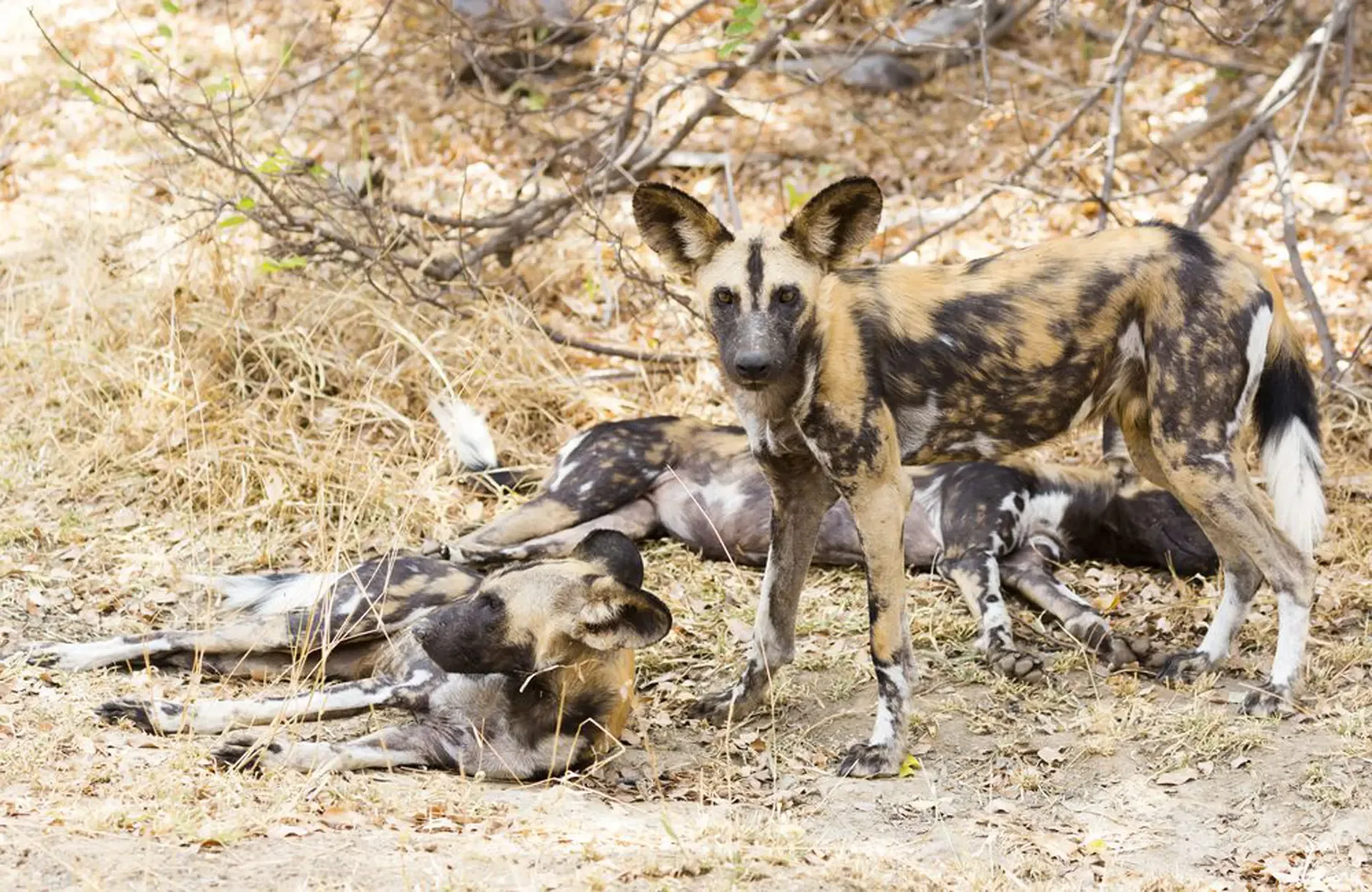
The African wild dog, Lycaon pictus, goes by several names: painted dog, painted wolf, Cape hunting dog. Pictus is Latin for painted, and the name fits. The coat is a patchwork of black, tan, white and yellow-brown, and no two dogs share the same pattern. Researchers use those markings to tell individuals apart from photographs. Add large rounded ears, a white-tipped tail and long legs built for endurance, and you have an animal that looks nothing like a domestic dog.
The species is listed as Endangered on the IUCN Red List. The 2020 assessment estimates about 6,600 adults spread across 39 subpopulations, of which only around 1,400 count as mature, breeding animals, and it describes the population as still declining. The main pressures are habitat being broken up, conflict with people and their livestock, and disease, especially rabies and canine distemper caught from domestic dogs. Wild dogs now survive in only 14 of the 39 countries where they once lived, and Tanzania is one of the most important of those that remain.
Packs usually number 10 to 15 dogs, sometimes many more. One dominant pair breeds, and the rest of the pack helps raise the pups, bringing food back to the den and guarding the young. They hunt together, mostly medium-sized antelope such as impala, running prey down over distance rather than stalking it. Even the decision to go hunting is shared: a 2017 study of packs in Botswana found that dogs "vote" by sneezing during the rally before a hunt, and that more sneezes are needed to get the pack moving when the dominant pair are not the ones starting it.
All of this needs space. A single pack can range over as much as 2,000 square kilometres, and dogs avoid areas crowded with lions and hyenas, which kill them and steal their kills. That is why they do best in very large, lightly settled landscapes, and why southern Tanzania matters so much.
Where to see wild dogs in Tanzania
Nyerere National Park (the former Selous): your best chance
The northern part of the old Selous Game Reserve became Nyerere National Park in 2019, and this is where the camps are. It was in the Selous that Scott and Joanna Creel ran the six-year study behind much of what we know about wild dog behaviour. A recent camera-trap survey, run between 2020 and 2022, identified 222 individual dogs across the Selous and Nyerere and concluded that the wider Selous-Niassa ecosystem is one of the most important remaining wild dog populations in Africa.
What makes sightings possible here is the variety of ways you can search. Camps sit along the Rufiji River and its chain of lakes, and as well as game drives you can take boat safaris on the river and, at some camps, guided walks. A good guide reads tracks on the sandy roads in the early morning and listens for the high, bird-like contact calls packs use. When a pack is denning, guides often know roughly where it is, which is why June to August is the time to come.
Ruaha National Park
Ruaha is Tanzania's other wild dog stronghold. The Ruaha Carnivore Project describes the wider Ruaha landscape as holding the third biggest population of endangered wild dogs in Africa, and the Wildlife Conservation Society ranks the Ruaha-Katavi population among the three most significant on the continent, alongside Nyerere-Selous and Zimbabwe's Hwange. In the dry months, game gathers along the Great Ruaha River and its sand rivers, and packs follow the impala.
Mikumi National Park
Mikumi is part of the wider Selous ecosystem and is the easiest southern park to reach, about 310 kilometres by road from Dar es Salaam on the Tanzam highway, which crosses the park. Wild dogs live here, but they are seen less often than in Nyerere or Ruaha. Treat a Mikumi sighting as a bonus on a short trip rather than the reason for it.
Serengeti and Loliondo
Wild dogs vanished from the Serengeti plains in 1991. They survived next door, in the Loliondo area and the Ngorongoro Conservation Area, where research reported in 2019 counted about 120 dogs in 10 packs, most of them in Loliondo. Packs do cross into the Serengeti from time to time, so a sighting on a northern safari is possible, but we would not plan a trip around it.
Mkomazi National Park
In 1995 the George Adamson Wildlife Preservation Trust, led in the field by Tony Fitzjohn, started East Africa's first captive breeding and release programme for wild dogs at Mkomazi, with packs released around the park and into southern Tsavo West in Kenya. Mkomazi is a national park today, but it is not a place to expect wild dogs on a game drive. Ask us about the current situation before you build a trip on it.
Wild dog areas in Tanzania compared
| Area | Chance of a sighting | Best months | Getting there | Style of safari |
|---|---|---|---|---|
| Nyerere | Best in Tanzania | June to October; dens often June to August | Light aircraft from Dar es Salaam (about 45 minutes to camp airstrips) | Game drives, boat safaris, guided walks |
| Ruaha | Good | June to October | Light aircraft from Dar es Salaam or Arusha | Long game drives along the Great Ruaha River |
| Mikumi | Possible, less common | June to October | About 310 km by road from Dar es Salaam | Game drives, short trips |
| Loliondo and the Serengeti | Occasional | Varies with pack movements | By road or air from Arusha | Part of a northern safari |
| Mkomazi | Not a reliable game-drive sighting | Ask us | By road from Arusha or Moshi | Conservation visit |
Best time to see wild dogs
The dry season, roughly June to October, is the time to go. The grass is short, water is scarce, and animals gather near rivers and lakes, so packs are easier to follow and spot. From November the rains return, the bush thickens and wildlife spreads out. Several camps in Nyerere close during the long rains from mid-March to May, and some southern roads become hard to use.
Within the dry season, June to August is usually the denning period in southern Tanzania. Packs then stay near a den for several weeks while the pups are too small to travel, and the adults return to it after each hunt. Timing shifts from year to year and pack to pack. Den sites are also sensitive: a pack disturbed at its den may move the pups, so guides keep their distance and limit time there.
For a month-by-month view of the whole country, see our Tanzania travel by month guides.
Conservation in Tanzania
Several long-running projects have shaped what is known about Tanzania's wild dogs:
- Tanzania Carnivore Programme. Set up by the Tanzania Wildlife Research Institute (TAWIRI) and the Zoological Society of London and based at TAWIRI in Arusha, it ran a "Wild Dog Watch" photo campaign that asked visitors and guides to send in pictures for identification, and held Tanzania's first national wild dog workshop in Arusha in February 2005.
- Ruaha Carnivore Project. Founded in 2009 by Dr Amy Dickman with Oxford University's Wildlife Conservation Research Unit, it studies lions, leopards, cheetahs, wild dogs and hyenas across the Ruaha landscape and works with villages to cut livestock losses and the killing of carnivores that follows.
- Mkomazi wild dog programme. The George Adamson Wildlife Preservation Trust's breeding and release work, begun in 1995, was the first of its kind in East Africa.
As a visitor, you help most by keeping your distance at dens, never asking a guide to drive off-road after a pack where that is not allowed, and, if you photograph dogs, sharing clear side-on pictures with researchers when they ask for them. Those coat patterns are how individual dogs are tracked.
Where to stay
These are the camps we book for wild dog safaris. The camp decides how you search, so choose by activity as much as comfort.
- Roho ya Selous, Nyerere. An Asilia camp of eight tents on Lake Nzerakera, among the park's lakes. Game drives, boat trips and walks. Open June to mid-March; children from five.
- Rufiji River Camp, Nyerere. Run by Foxes Safari Camps on the bank of the Rufiji and said to be the first camp built in the park. Boat safaris, walking safaris, game drives to the nearby lakes and fly camping. Walks are for guests aged 12 and over.
- Ruaha River Lodge, Ruaha. Inside the national park, on a rocky ridge above the Great Ruaha River, close to the dry-season game.
- Vuma Hills Tented Camp, Mikumi. A Foxes camp of 16 tents in the south-west of the park, looking out over the plains. A practical stop by road between Dar es Salaam and Ruaha.
How to add the south to your safari
We arrange southern safaris tailor-made rather than as a fixed package, because the right route depends on how many days you have, where you fly in and out, and whether you are also going north or to Zanzibar. Common shapes are a fly-in trip to Nyerere and Ruaha from Dar es Salaam, a road trip through Mikumi on the way to Ruaha, or a few nights in Nyerere added to a northern safari from Arusha. For the best odds, give the south at least three nights in one park, ideally in June, July or August.
Tell us your dates and what you want to see in the safari planner, or contact our team in Arusha and a planner will suggest a route. For the rest of the country, start with our Tanzania destination guide, and if you are still deciding which animals to prioritise, our piece on the Big Five in the Serengeti covers the north.
Questions
Wild dog questions
<p>Yes. Painted dog, painted wolf, African wild dog and Cape hunting dog are all names for <em>Lycaon pictus</em>.</p>
<p>The IUCN's 2020 assessment estimates about 6,600 adults in 39 subpopulations, around 1,400 of them mature breeding animals. The species is listed as Endangered and is still declining.</p>
<p>The dry season, June to October. June to August is usually denning time in the south, when packs stay near one place for several weeks, which makes them easier for guides to find. Timing varies by year and by pack.</p>
<p>Occasionally. Wild dogs disappeared from the Serengeti plains in 1991 but survive in neighbouring Loliondo and Ngorongoro, and packs sometimes cross into the park. For a real chance, plan time in Nyerere or Ruaha.</p>
<p>No, and be wary of anyone who does. Packs range over very large areas. What we can do is put you in the right park, in the right months, with camps and guides that give you the best odds.</p>